TikTok research interviews: Seeking LGBTQ+ people aged 16-25 years to discuss TikTok

Now seeking interview participants who are LGBTQ+, based in Australia, and aged 16-25 years, to discuss LGBTQ+ mental health peer support on TikTok.

Interviews will be conducted online (via Zoom), commencing in April 2025. Interviews will run for 30-60 minutes and will be audio-recorded. Participation will be anonymous, and participants will receive a voucher valued at $50 for their contribution.

Places are limited, so please reach out soon if interested.

To register your interest, please complete the short survey at this link.

If you have further questions, you can email Paul Byron on paul.byron@uts.edu.au.
Informal digital peer support for mental health: understanding the digital support practices of LGBTQ+ young people in Australia (journal article)

A new journal article from the Digital Peer Support study was recently published, authored by Paul Byron (UTS) and Lisa McDaid (UQ). The paper uses survey data from LGBTQ+ young people in Australia to explore their informal peer support practices regarding mental health. We consider how participants’ everyday social media use offers an important site for mental health support and we draw attention to the social media platforms, people, and digital practices involved in this support. We argue that attention to these informal care practices can improve our understanding of what care and support looks and feels like for many LGBTQ+ young people, which can in turn guide formal and community-based mental health initiatives. The paper is open access and can be found here. We wish to thank all LGBTQ+ young people who contributed responses to this survey.

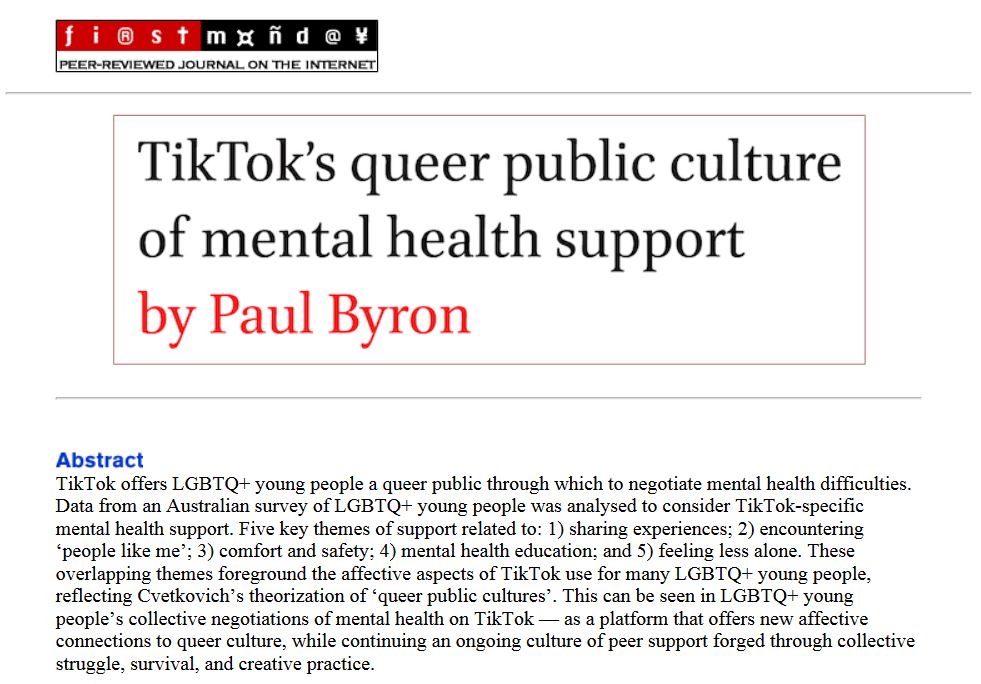
Journal article: TikTok’s queer public culture of mental health support

The first academic journal article from the Digital Peer Support study came out last week. Presenting survey data from LGBTQ+ young people, the article discusses how TikTok use can provide important mental health support for many LGBTQ+ young people. It particularly frames TikTok as part of queer public culture – an accessible resource for connecting to and participating in queer life. The article is open access and can be found here.

Here’s the article abstract:

Screenshot of the article title, author, and abstract, available at the above link

I’d like to acknowledge the 660 people who took part in the Digital Peer Support survey, therefore informing this discussion of TikTok mental health support. Thanks also to the amazing Advisory Committee for shaping and informing the study, and to Tisha Dejmanee (UTS) for providing close feedback on an earlier draft.

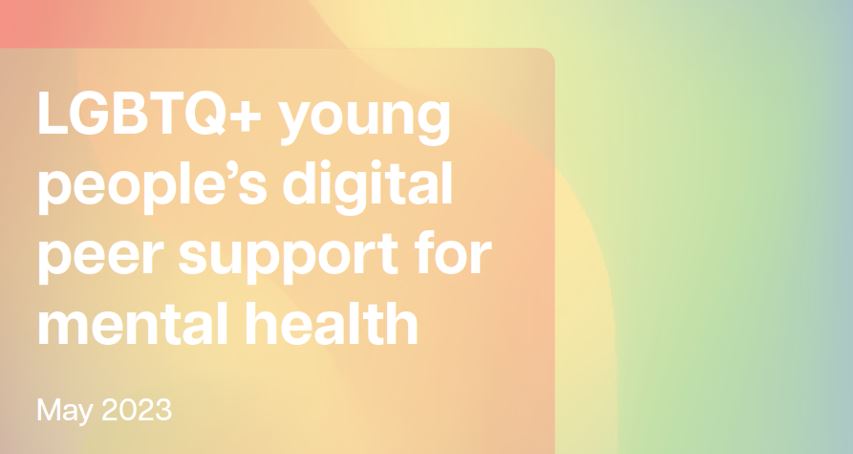
Report: LGBTQ+ young people’s peer support for mental health

Our project report based on research with 674 LGBTQ+ young people in Australia is now available, offering insight into what digital peer support means to LGBTQ+ young people, and how mental health is negotiated, both personally and collectively, through digital media.

The report presents findings from a national survey and interviews with LGBTQ+ young people aged 16-25 years. For this study, digital peer support comprises informal, digital and social media engagement with friends and peers. Findings demonstrate how LGBTQ+ young people support each other in ways that families, schools, and health practitioners cannot. Taking a strengths-based approach to LGBTQ+ young people’s experiences, participants are engaged as digital peer support experts. Centring LGBTQ+ young people’s digital cultures is central to this study’s goal to enrich current healthcare practices, strategies, and policies relating to LGBTQ+ young people’s mental health.

You can download the full report HERE.

Interview participants sought

The LGBTQ+ young people, mental health and digital peer support project is seeking to interview staff and volunteers who work with LGBTQ+ young people in Australia.

Participants may work within the LGBTQ+ youth support sector in Australia, or may have a role within an organisation or local community group in which they support LGBTQ+ young people.

We seek to interview people from a range of organisations, communities and locations, so please get in touch if interested, and please share this notice to your networks.

See here for more about this study or email paul.byron@uts.edu.au.

LGBTQA+ young people sought for INQYR research advisory group

The Australian Regional Network of INQYR (International Partnership for Queer Youth Resilience) invites LGBTQA+ young people, 14-21 years, to join the team’s Advisory Group.

INQYR is a research partnership that aims to connect researchers, service providers, and LGBTQA+ young people to collaboratively conduct technology-focussed research on resilience and wellbeing in LGBTQA+ young people, through regional networks in Canada, US, UK, Mexico and Australia.

The Advisory Group will oversee and provide input to research activities of the Australian Regional Network, working alongside community stakeholders. Members will be invited to attend 2-3 meetings a year and will be paid for their attendance.

To register your interest, please answer some quick questions HERE

You can find out more about INQYR here, and you can see who’s part of the Australian Regional Network here.

Please email Paul Byron (paul.byron@uts.edu.au) if you have any questions.

Interview participants sought: LGBTQ+ young people 16-25 years, living in Australia

Last year we conducted a survey of LGBTQ+ young people (16-25 years) in Australia. We’ve been following this up with interviews, and we’re seeking more participants.

Interviews will be conducted online (via Zoom) in August/September 2021. Interviews will run for up to 1 hour and will be audio-recorded. Participation will be anonymous and you will receive a shopping voucher valued at $50 for your contribution.

Places are limited, so please register HERE soon if interested.

Registering involves completing a 1-minute questionnaire asking for details of age, location, gender, sexual identity/orientation, cultural identity/background, and disability. This is to ensure we get a diverse range of participants.

Email Paul on paul.byron@uts.edu.au if you have any questions.

Project Report: LGBTQ+ young people, COVID-19, & service provision in Australia

This month we released early findings from our national survey of 660 LGBTQ+ young people (16-25 years) that ran from August-November 2020. While the survey asked a range of questions relating to mental health, social media, and peer support, this report focuses on questions asked about COVID-19 and associated lockdowns, and how these impacted survey participants. We consider these data alongside interviews conducted with Twenty10 staff and volunteers in late 2020.

We report on 5 questions asked of survey participants in relation to COVID-19, alongside data from 11 interviews with Twenty10 staff and volunteers who support LGBTQ+ young people in NSW. As a result of COVID-19, Twenty10 suspended drop-in services in 2020, and developed new ways to support young people, including the development of a Discord server. Staff and volunteers report on the challenges of LGBTQ+ youth service delivery during a pandemic, and discuss the needs for the LGBTQ+ support sector into the future.

We hope the report is valuable to LGBTQ+ service providers, communities, and researchers, here and abroad. This project was also designed to support Twenty10, as our research partner, and was funded by the Centre for Social Justice and Inclusion at the University of Technology Sydney.

Many thanks to all survey and interview participants for sharing their experiences. The report can be found HERE.

Social Impact grant

From a Social Impact Grant received from the UTS Centre for Social Justice and Inclusion in 2020, we have added questions to our national survey of LGBTQ+ young people regarding their experiences of COVID-19 ‘lockdowns’ and how this may have impacted mental health support. We will also interview staff and volunteers from Twenty10, as partner organisation for this grant. This research will be undertaken by Paul Byron (UTS), Kerry Robinson (WSU), Cristyn Davies (USyd) and Sab D’Souza (UTS). The survey will be launched this month.